It is 10:30pm and I just spent over an hour preparing a one-person dinner meal.
Sometimes I scare even myself.
It is 10:30pm and I just spent over an hour preparing a one-person dinner meal.
Sometimes I scare even myself.
DaveCorp Gardening International, has announced the diversification of their portfolio. Keeping their recent investments in CTRO, MINT and BSIL, and staking new positions in A.MINT, L.GRAS and L.BSIL…
Market analysts are very optimistic on the Summer prospects of DaveCorp Gardening International and predict a bullish market on delicious Thai curries and fresh mojitos1The real kind, using apple mint & spearmint, not that poor ersatz some people make with peppermint..

(dark-chocolate with kaki-pumpkin cream-cheese frosting, in case you were wondering)

Post-meeting dinner with visiting Todai researcher and incidentally major wine amateur: any day, really…
In case you were also wondering, I confirm: whip cream does not make an adequate substitute for milk in your breakfast cereals. No matter how desperate and in a hurry you are.
 This year, I purchased and brought back a couple Muji 「 クリスマスへクセンハウス」 (no idea what “へクセン” might be, but I’m sure it’s delicious*) for everybody to enjoy… As it turns out, my dear little brothers out there in Canada had a hard time reading cooking instructions (sure: they’re written in Japanese. so what). Here is therefore the detailed recount of my own attempt at building a biscuit house, for their sake and yours.
Should you attempt to follow, it will help if you have the same awesome Muji kit handy, but an inventive and resourceful person could do without (none of the ingredients are that hard to find, and the schematics can probably be figured out from scratch with limited engineering skills). Also, this is not a completely faithful translation of the original instructions: I have added a couple personal touches as well as skipped the more obvious advices (be careful with the knife, do not stick your tongue in the oven etc.).
Anyway, off we go:
Yesterday, I had convincingly authentic Japanese food for the first time in Paris and felt it deserved a mention here.
Issé restaurant (“tempuras & tapas”) has a soberly stylish decoration and seemingly caters to a large japanese-speaking clientele, both reassuring points when compared to the flurry of Chinese-speaking sushi chefs and horrifyingly cheesy pseudo-oriental kanji signs, customary of most other places that claim to offer Japanese cuisine in this city.
The menu there is classic, yet not stereotypical, which means a lot of small dishes, no ramen, and only a few makis on offer. Somewhere between a typical Tokyo restaurant and a high-end izakaya (lots of the same food, but less greasy): we had loads of tempuras (shiso, seafood, a bunch of other veggies… even mozzarella…), seaweed salad, agedashi tofu, and a couple other dishes. All great and tasty (ok: I reckon my agedashi tofu is better, but I may be biased) and infinitely more reminiscent of the whole Tokyo experience than many a j-food joints on rue Saint Anne.
Prices were about average to high, but very reasonable for the quality of food (around 20-30 euros/person for dinner and a drink).
And for those who ever lived in Japan: sit there, sipping an iced ohlong-cha with schochu and nibbling on edamame, and I swear you won’t be able to shake the natsukashiness away.
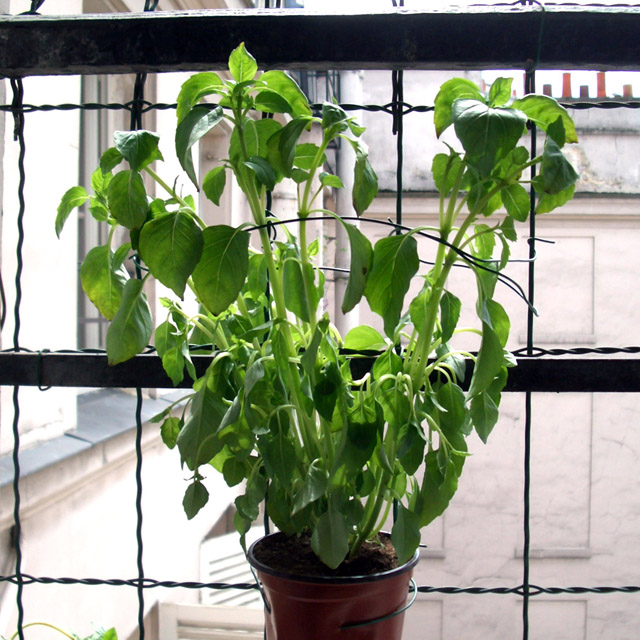 Team, we need differential diagnostic, NOW:
Patients #1, #2, #3 and #4 – a family – let’s call them the Lamiaceaes, were admitted in mid-April: sharing a rather small room, but healthy and showing no sign of infection. They were kept indoors and put on a steady diet of H2O, administered twice daily.
Within days following their admission, they showed signs of discomfort: all limbs progressively went numb, patients could no longer stand upright without assistance. Their health deteriorated exponentially over the course of a week. Finally, patients #1, #2 and #3 all underwent cardiac arrest, followed by acute dehydration, to be declared clinically dead on the seventh day after several failed attempts at resuscitation. Patient #4, youngest member of the family, entered a vegetative state but, in the end, miraculously survived: he emerged from his coma a few weeks later and has been making such an encouraging recovery ever since that doctors have allowed his relocation to the outdoor patio.
It was diagnosed at the time that overcrowding of their room, conjugated with possible lack of fresh air may have caused the sudden and unexpected death of all but one of the Lamiaceaes. Endemic condition or residual infection caught at their previous place of residence was not completely excluded, albeit impossible to prove and somewhat invalidated by the survival of the weakest family member.
Patient #5, whom we shall call Basil, a large-sized fully-grown adult, was admitted two days ago.
A while back, I posted about finding some specific ingredients in Paris (mainly Japanese but also Thai and generally all sorts of non-French food) without having to pay for overseas shipping each time.
Following some kind readers’ suggestions and with a bit additional exploration, I have since resolved all my culinary woes. I figured I’d post a quick recap and a few extra advice for the sake of past and future seekers of exotic food in Paris:
First off: the bestest, cheaperest, fresh tofu, along with countless other goodies (can you believe they even had konnyaku!?!) was found at Supermarket Paris Store on Avenue d’Ivry (about 10 minutes from Place d’Italie, on the left side), thanks to Chrys, whom we shall dearly miss now that she has relocated…
Unlike most other Asian stores in the area (Tang Frères etc.), this one stocks up a fairly consequent aisle of typically Japanese products.
Of course they also carry the usual south-east asian fare, though their curry paste didn’t turn out all that convincing to my humble curry-loving tastebuds (their coconut paste: not at all). But these are much easier to find anywhere else in the neighbourhood… I still want to find some of this mucho combiniente cononut powder (same taste, much lighter to carry around), but the canned stuff is available everywhere… On my next trip, I might even try some of their kimchee (kimchee ramen… yay!).
… that I haven’t had a proper BLT sandwich.
Where do they hide the bacon in this damn country?
Do I have to start raising pigs in the courtyard of my building?